In this guide
The best tips for creating a resume are not decoration tricks or keyword formulas. A good resume helps a reader quickly understand what you can do, where you proved it, and why that evidence matters for the role in front of them.
The short version
- Lead with relevant evidence instead of a generic career biography.
- Make each bullet easy to scan, specific enough to discuss, and honest enough to defend.
- Review the final exported file, not only the editable document.
1. Write for a role, not for every possible role
A resume that tries to cover your entire working life usually hides the evidence that matters most. Start by identifying the responsibilities, tools, and outcomes repeated in the job description, then give the closest evidence more space.
Tailoring does not mean copying every phrase from the posting. It means selecting and ordering truthful experience so the connection is easy to see.
2. Make the first third earn attention
Name, contact details, a concise target summary when useful, and your most relevant recent experience should be immediately understandable. Remove a long objective that explains what you want without showing what you offer.
If you use a summary, keep it concrete: role identity, domain, useful scope, and one or two strengths supported later in the resume.
3. Replace duty lists with evidence
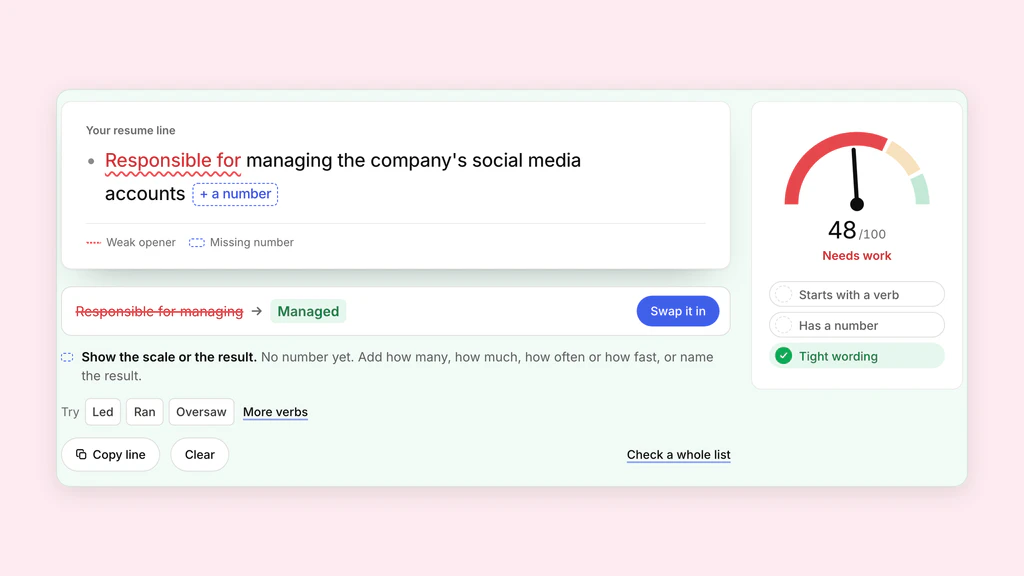
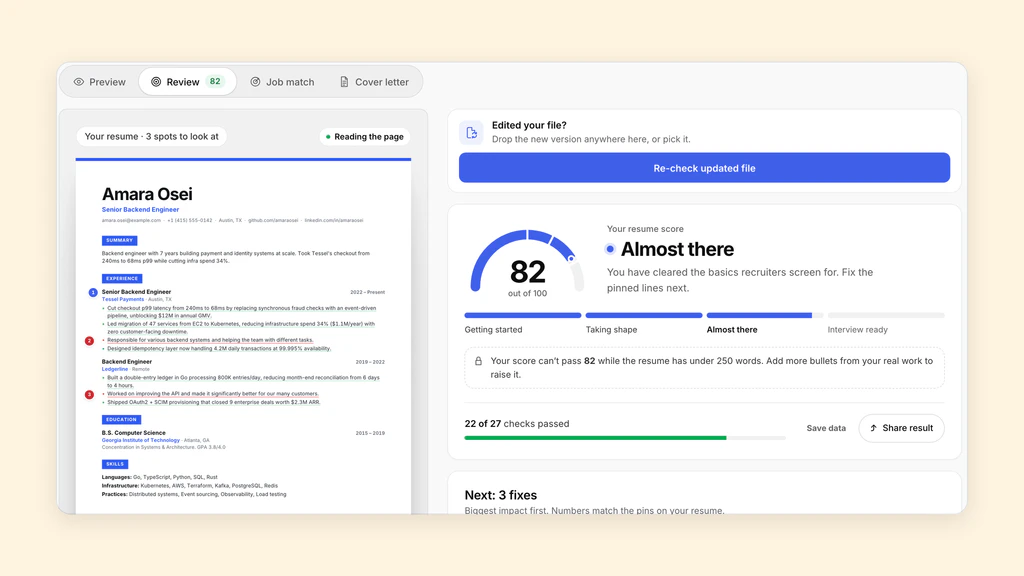
Responsibilities explain what the job required. Accomplishment bullets explain what you did with that responsibility. Add the object of the work, its scope, the problem, or the result.
- Prefer “Resolved billing and access issues across email and chat” to “Responsible for customer service.”
- Use accurate counts, ranges, frequency, or time when records support them.
- When a number is not available, describe the process changed, risk reduced, or handoff improved.
4. Use plain, specific language
Strong writing is usually shorter and more concrete, not more corporate. Replace phrases such as “results-oriented team player” with evidence of the result and collaboration.
Start bullets with the action or outcome, vary verbs where it improves accuracy, and cut filler that could describe any candidate.
5. Keep the structure predictable
Use conventional headings such as Experience, Education, Skills, and Projects. Keep employer, title, location, and dates grouped together. Use reverse chronological order unless a different structure has a clear reason.
Predictability helps both hurried readers and software. Originality belongs in the evidence, not in making someone decode the page.
6. Let relevance determine length
One page is useful when it forces an early-career resume to stay focused, but it is not a universal rule. A second page can be appropriate when it contains relevant evidence rather than repetition.
Do not shrink type until the page becomes uncomfortable to read. Edit weak content before compressing useful content.
7. Treat the skills section as an index
List skills you can use and discuss, grouped in a way that helps the reader scan them. The experience section should then prove the most important ones in context.
Avoid visual rating bars. “Four out of five” has no shared meaning, while a project or achievement demonstrates actual use.
8. Proofread facts before polishing style
Check phone number, email, links, employer names, dates, job titles, and tense consistency. A beautiful resume with a broken portfolio link is still broken.
Read it aloud, review it once from the bottom upward, and ask another person to identify anything they cannot understand without explanation.
9–12. Finish with four file checks
The final review should cover presentation and extraction. Open the exported file on another device or viewer when possible.
- Confirm that no bullet, date, or heading was pushed onto an unintended page.
- Use a clear filename such as Firstname-Lastname-Resume.pdf.
- Test every link and remove document comments or tracked changes.
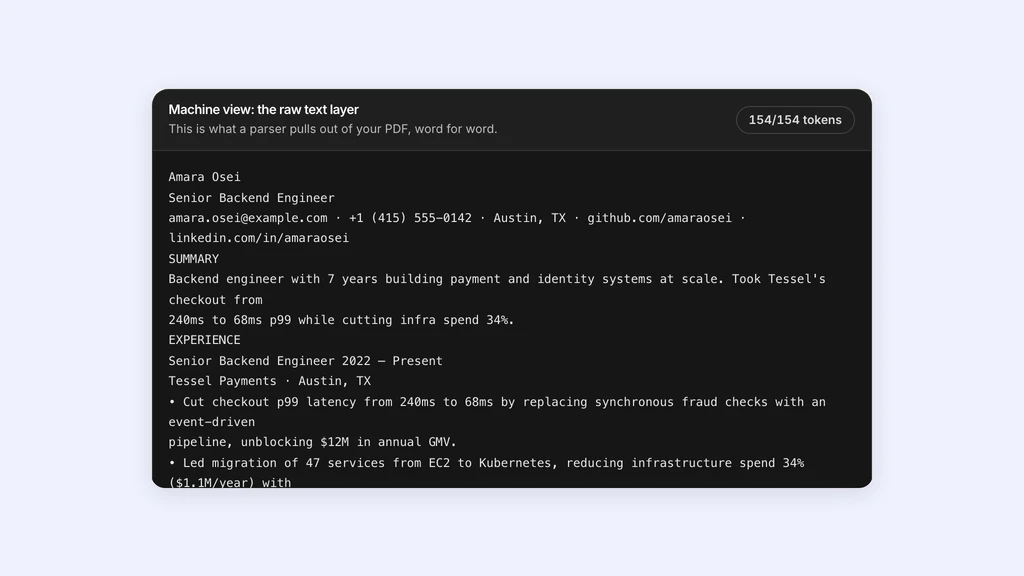
- Extract the text and confirm that the reading order still makes sense.
The best checklist is the one you repeat. Save a clean master resume, tailor a copy, then run the same factual and final-file checks before every submission.
Your final check Run it before every send.
Phone, email, links, employer names, dates and job titles. Then check that the tense stays consistent.
Ask one other person to point at anything they can't follow without you explaining it.
On another device or viewer, check that no bullet, date or heading slipped onto the wrong page.
Something like Firstname-Lastname-Resume.pdf, so it is easy to find in a recruiter's downloads.
Click each one in the exported file, and remove any comments or tracked changes.
The order should still make sense as plain text. That is the version a parser works from.
Ready to send. Good luck with this one.
Keep a clean master resume, tailor a copy for each job and run this list again. Once it's sent, add the job to your tracker.
Try tips 1, 3 and 4 on your own resume. Free, in your browser.
Sources and further reading
- Create a resume, CV, or cover letter, Harvard FAS Mignone Center for Career Success
- Résumé workshop, Purdue Online Writing Lab
- Create and verify PDF accessibility, Adobe
Put it into practice on a real resume.
Each example is a complete resume with role keywords and bullets that show proof. Open one in the Studio and make it yours, then download it with a free account.