A scanner that compares one resume against one job posting and returns a match rate plus the keywords it thinks are missing.
ATSPrep is not that. It reads your existing PDF the way a parser does and shows you what came back out of it, then verifies the file it exports for you the same way — free, with no account, and without the file leaving your browser.
No price is quoted here on purpose. Vendors run promotions and regional pricing, so a number copied into this page would be stale within weeks. The link always resolves to today's figure.
From their own documentation
What Jobscan says about your resume
You upload the resume file and paste the posting, and the comparison runs on Jobscan's servers. Its pricing lives inside the same logged-in app.
None of that is a criticism. Storing the document server-side is what makes an account, saved versions and cross-device editing possible, and those products could not work any other way. ATSPrep made the opposite trade: it parses and exports in the browser, which is why it can be free and why there is nothing to sign up for — and also why it cannot save your work to the cloud.
What you actually get
The extraction, not a grade for it
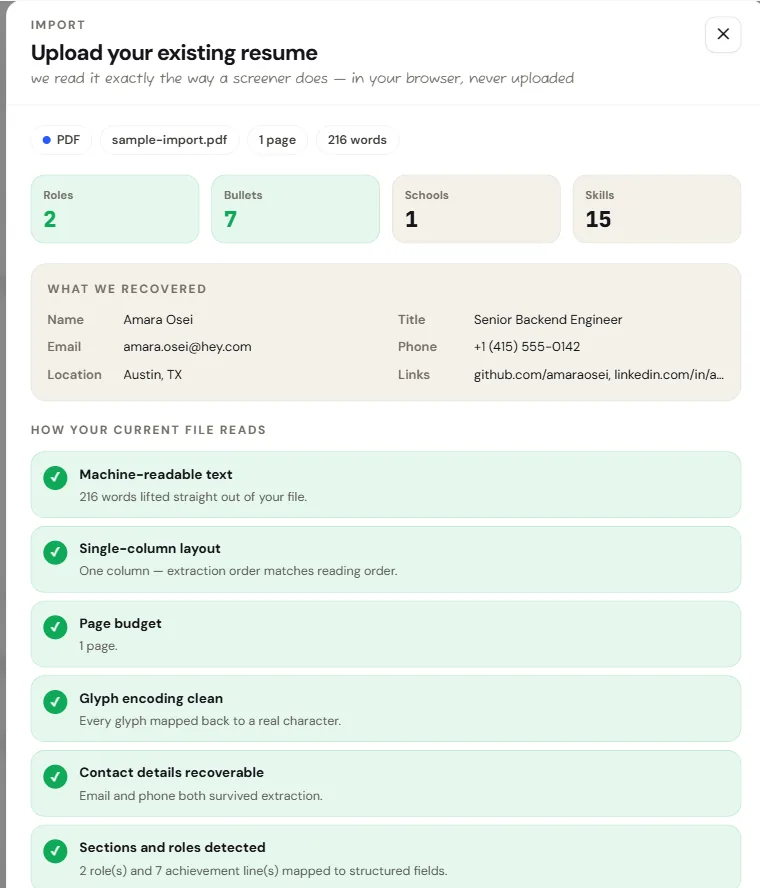
Bring the PDF Jobscan produced and ATSPrep runs it through a PDF text extractor, then shows you what came back out. The same check runs again on the file it exports for you.
An imported PDF, read the way a parser reads it. A two-column layout or an image-only export fails these checks immediately — which is the thing a score out of 100 cannot tell you.
The actual decision
Which one you should use
Choose Jobscan if
→Keyword match rate against a specific posting is the number you want to optimise.
→You want LinkedIn review, a tracker and a browser extension in the same subscription.
→You are applying at volume and want tooling that follows you across job boards.
Depth of job-description matching, and breadth of everything around it — LinkedIn optimisation, a job tracker, and a browser extension that follows you across job boards. ATSPrep matches a posting too, but it is not trying to be a job-search suite.
Choose ATSPrep if
→You want to see the extracted text itself, not a percentage derived from it.
→You would rather not sign up to check one document.
→You want to know the export survives conversion — columns, headings and dates intact — before keywords are even the question.
The 6 ATS guides on this site document what each system accepts, sourced to the vendor.
Verdict
You can use both, and most people should
Jobscan answers "does this resume contain the words in this posting?" ATSPrep answers "does a parser get this resume out in one piece?" Keyword coverage is worth very little if the section headings collapsed during extraction, because the keywords end up attached to the wrong role or lost entirely. Check the structure first; optimise the wording second. ATSPrep also matches a pasted job description, so for a single application you may not need both.
No account, no payment, and the file is read in your browser.
Questions
ATSPrep and Jobscan, briefly
Is ATSPrep free?
Yes. Checking, importing, editing and exporting are unpaid, there is no export paywall, and the exported PDF carries no watermark. ATSPrep's separate Job Hunt Pass is only a demand test today. For what Jobscan costs now, read their own pricing page — prices change too often for a figure here to stay accurate.
Do I need an account to use ATSPrep?
No — the Studio needs no account, and the resume file is read in your browser rather than uploaded. An optional checklist or waitlist email never blocks it. Jobscan works differently: scanning runs in the Jobscan web app, which opens with a log-in or sign-up.
Can I use both ATSPrep and Jobscan?
Yes, and for most people that is the sensible answer. What Jobscan does better: depth of job-description matching, and breadth of everything around it — LinkedIn optimisation, a job tracker, and a browser extension that follows you across job boards. ATSPrep matches a posting too, but it is not trying to be a job-search suite. If you write the resume there, drop the finished PDF into the ATSPrep importer: it reads that file with a real PDF text extractor and reports what came out of it — whether the text layer is machine-readable, whether the layout resolves to one column, and whether your contact details survived.