In this guide
A cover letter template saves time only if it keeps what the reader is looking for: the job you want, proof you can do it and a clear next step. The ten templates below are complete letters with the specifics left as highlighted gaps. Pick the one that fits your situation, copy it, and fill the gaps with facts from your own work.
The short version
- Choose a template by situation (referral, career change, internal move, short note), not by how the page looks.
- Keep it to one page, roughly 250 to 400 words, and name the role and company in the first two sentences.
- Fill every gap with something you actually did. If a sentence could go to any employer unchanged, rewrite it.
What makes a cover letter template actually useful?
Purdue's Center for Career Opportunities breaks a cover letter into four parts: the header and greeting, an introduction that says which job you want, your accomplishments and what you'd bring, and a close that thanks the reader. A useful template keeps that shape and makes you fill in the parts that change from job to job: the role, why this employer, and the evidence that you fit.
Weak templates skip the third part. They go straight from “I am excited to apply” to “I look forward to hearing from you” and leave nothing in between for the reader to weigh. That is the paragraph that links your resume to the job posting, usually through one specific project or result that matches what the role needs.
A quick test: if you can swap the company name and send the same letter somewhere else, it is still a template, not a letter. Every template here has gaps that force the swap to be more than a name.
How long should a cover letter template be?
One page, and usually 250 to 400 words. That is enough for an opening that names the job, one or two paragraphs of evidence and a short close. It is also short enough to read in about a minute.
If your draft runs past 400 words, look for repetition before you look for a smaller font. A long letter rarely reads as more interested. It reads as less edited. The exception is a short note: when an application form gives you a small text box, 100 to 150 words is plenty.
The ATSPrep cover letter builder counts words under the letter as you type. It aims for 200 to 400 words on the Classic and Career change templates and 150 to 300 on Direct.
What are the 10 best cover letter templates for fast job applications?
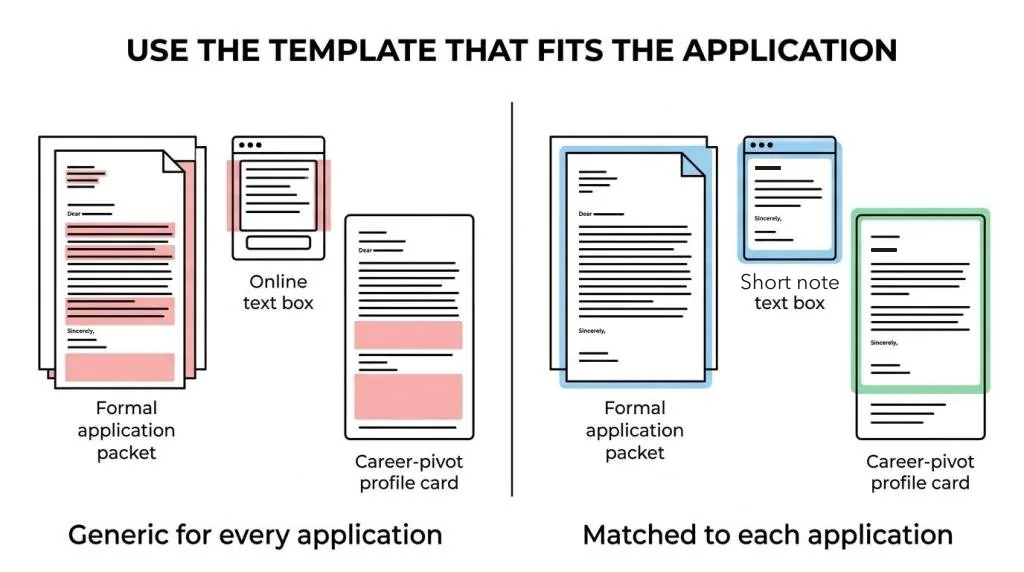
Each template below is written for a realistic role so you can see the level of detail it needs, but the structure works for any job. Highlighted text in brackets is a gap for you to fill. Copy the template, paste it into your editor, and replace every gap before you send it.
Templates 1 to 3 match the three layouts in ATSPrep's free cover letter builder, which fills them from your answers on a live page. Templates 4 to 10 cover situations the builder doesn't have a layout for yet.
- Classic: the default for most applications that ask for a letter.
- Direct: three short paragraphs that open with your best result.
- Career change: explains how your current work carries over to a new field.
- Referral: for when someone at the company pointed you to the job.
- Entry-level: turns coursework, projects and part-time work into evidence.
- Achievement-first: leads with one result that maps straight onto the role.
- Internal application: for a move or promotion inside your current employer.
- Mission-fit: for nonprofits, schools and public services where motivation matters.
- Email cover note: a short message for the body of an email.
- Return to work: a brief, confident line about a career break.
Dear [Hiring manager's name],
I'm applying for the Marketing Manager role at [Company], which I found on [where you saw it]. I've spent [number] years running B2B campaigns for [type of product], and the focus in your posting on [priority from the posting] is the work I enjoy most.
At [Current employer], I own paid search, email and webinars for [product or team]. Last year I [result, e.g. rebuilt the nurture sequence and raised demo requests by X% over two quarters]. I also [second result, e.g. set up the reporting the sales team now uses to score leads].
I want to work at [Company] because [specific reason: a product, a market or a recent launch]. I'd bring the same habits there: test small, measure honestly and keep sales in the loop.
Thank you for your time. I'd welcome the chance to talk about how I could help [team or goal from the posting].
Best regards, [Your name] [Phone] · [Email]
Dear [Company] hiring team,
I [best result, e.g. cut API response times by X% by redesigning our caching layer], and I'd like to do that kind of work as a Software Engineer at [Company].
I've worked in [languages and tools from the posting] for [number] years at [Current employer], mostly on [area, e.g. backend services that handle payments]. Your posting mentions [requirement]; I [one line on where you've done it].
I'd be glad to walk you through the details. Thank you for considering my application.
Best regards, [Your name] [Phone] · [Email]
Dear [Hiring manager's name],
I'm applying for the Instructional Designer role at [Company]. For [number] years I've taught [subject] to [age group or audience], and for the last [time period] I've been designing the course materials my department now uses.
Much of the job you describe is work I already do. I [result, e.g. rebuilt the Year 9 science unit around short online modules, and pass rates rose from X% to Y%]. I write learning objectives, build assessments and revise them when the results show a gap.
The part that's new to me is [skill you're still building, e.g. authoring tools like Articulate]. I've been closing that gap through [course, project or volunteering], and I've attached [portfolio link or sample].
I'd like to bring a teacher's sense of what actually helps people learn to [Company]'s [product or team]. Thank you for considering my application.
Best regards, [Your name] [Phone] · [Email]
Dear [Hiring manager's name],
[Referrer's name], who works with you on [team], suggested I apply for the Staff Accountant role at [Company]. We worked together at [shared employer or context], and [he/she/they] thought my background in [area] would fit your team.
I'm currently a [job title] at [Current employer], where I handle [month-end close, reconciliations, or another duty from the posting] for [scope, e.g. three entities]. I [result, e.g. shortened the close from X to Y working days by automating the bank reconciliations].
Your posting mentions [requirement]. I [one sentence of proof].
Thank you for your time. I'd welcome the chance to talk about the role.
Best regards, [Your name] [Phone] · [Email]
Dear [Hiring manager's name],
I'm applying for the Graduate Data Analyst role at [Company]. I finish my degree in [subject] at [university] in [month and year], and I'd like to start my career on a team that [something specific about their data work].
In my final-year project I [what you did, e.g. cleaned and analysed X rows of public transport data in Python to find the routes with the longest delays]. I presented the findings to [audience] and [what happened next].
Outside my course, I [part-time job, society role or internship] where I [one result or responsibility that shows reliability or skill].
Your posting asks for [skill 1] and [skill 2]. I've used both in [where], and I'm happy to share my code or report.
Thank you for considering my application.
Best regards, [Your name] [Phone] · [Email]
Dear [Hiring manager's name],
Last year I [headline result, e.g. closed X new accounts in the mid-market segment, finishing at Y% of quota]. I'd like to do the same as an Account Executive at [Company].
Most of those deals came from [how, e.g. outbound to operations leaders in logistics], which looks close to the market your posting describes. I run my own pipeline from first call to signature and keep [CRM] up to date so forecasts hold.
I'm drawn to [Company] because [specific reason]. I'd welcome a conversation about your targets for the year and how I'd approach them.
Thank you for your time.
Best regards, [Your name] [Phone] · [Email]
Dear [Hiring manager's name],
I'd like to be considered for the Support Team Lead role posted on [internal job board]. I've been a [current title] on the [team] team for [time], and I've already been covering parts of this role.
Since [month and year], I've [leadership evidence, e.g. onboarded four new starters and run the weekly queue review]. I also [result, e.g. wrote the macros that brought first-reply time down from X to Y hours].
I know our customers, tools and escalation paths, so I could focus on the team from the first week. [Manager's name] is aware I'm applying and is happy to talk with you.
Thank you for considering me.
Best regards, [Your name] [Phone] · [Email]
Dear [Hiring manager's name],
I'm applying for the Program Coordinator role at [Organisation]. [One honest sentence on why this cause matters to you, e.g. I volunteered at a food bank for three years and saw how much depends on good coordination].
In my current role at [Employer], I coordinate [what, e.g. a volunteer rota of X people across two sites]. I [result, e.g. moved scheduling to a shared calendar, which cut no-shows noticeably over one season].
Your posting mentions [requirement, e.g. reporting to funders]. I [one sentence of proof].
I'd be glad to talk about how I could support [program name]. Thank you for your time.
Best regards, [Your name] [Phone] · [Email]
Subject: Administrative Assistant application: [Your name]
Dear [Name or hiring team],
I'd like to apply for the Administrative Assistant role at [Company], and I've attached my resume. I currently support [number] managers at [Employer], where I [one result, e.g. took over diary management and travel booking and cleared a two-month invoice backlog].
I'd be glad to talk at a time that suits you.
Best regards, [Your name] [Phone] · [Email]
Dear [Hiring manager's name],
I'm applying for the Project Manager role at [Company]. I've spent [number] years running [type of projects], and I'm returning to work after [time] spent [caring for family, study, travel, or another brief reason].
Before my break, I led [project] at [Employer], [result, e.g. delivering a system migration for X users on schedule]. During the break I [anything recent and relevant, e.g. renewed my PRINCE2 certificate or volunteered as treasurer for a local club].
Your posting asks for [requirement]. I [one sentence of proof].
I'm ready to commit fully to a role like this one and would welcome the chance to discuss it. Thank you for your time.
Best regards, [Your name] [Phone] · [Email]
How do you tailor a cover letter template in 3 steps?
Start from the job posting, not from your last letter. The posting tells you which skills, tools and outcomes the employer cares about. Your job is to decide which of your experiences proves them.
- Pull the top three priorities from the posting. They are usually a skill, a scope (team size, budget, customers) and an outcome.
- Match each priority to one concrete example from your work, study or projects. One sentence each is enough at this stage.
- Rewrite the first paragraph so it names the role, the company and your strongest match in plain words.
If the posting stresses working with stakeholders, don't lead with technical depth alone. If it stresses speed and ownership, pick examples where you moved fast and owned the result.
What should the first paragraph of a cover letter say?
Purdue's career centre advises stating the position straight away and how you heard about it, and mentioning a referral if you have one. Add one reason you fit, and you have an opening that answers the reader's first three questions: which job, how you found it and why you.
Compare two openings. “I am excited to apply for this opportunity” tells the reader nothing. “I'm applying for the Marketing Manager role, and I've spent four years running B2B demand campaigns like the ones in your posting” gives them something to check against your resume.
How do Classic, Direct and Career change cover letter templates compare?
These are the three layouts in the ATSPrep cover letter builder, and they cover most applications. The difference is how much room each one gives you to explain.
Direct is the fastest, but it leaves no space for context. If your background lines up neatly with the job, that's fine. If your story needs a sentence of explanation, such as a new field or a gap, Classic or Career change gives you room to make the case.
| Template | Shape and best use |
|---|---|
| Classic | Four paragraphs. Most jobs that ask for a letter. |
| Direct | Three short paragraphs, best result first. Optional letters and brief notes. |
| Career change | Adds a bridge to the new field. A title that doesn't match the job. |
Should a cover letter repeat your resume or add new evidence?
Add to it. Purdue's career centre suggests telling a story that isn't already on your resume. Restating job titles and dates wastes the space.
Use the letter for what a resume can't carry well: why this employer, why now, and the context behind one result. If your resume says you cut onboarding time, the letter can explain what was broken, who you had to convince and why that matters for this job.
How do you write the body paragraph in 3 steps?
The body is where a letter either earns its place or doesn't. Keep each paragraph to one idea and use this order.
- Match: name one requirement from the posting, such as forecasting, SQL or client communication.
- Prove: give one example with the situation, what you did and what changed. A clear outcome without a number is fine if you don't have one.
- Connect: say in one sentence how that example prepares you for this job.
One well-explained example beats three half-finished claims. If you have two strong ones, use two short paragraphs rather than one long block.
How do you close a cover letter in 3 steps?
A good close is short and practical. You're asking to keep the conversation going, not making a final speech.
- Thank the reader for their time.
- Say you'd welcome the chance to talk about the role.
- Sign off with your name, phone number and email, and check that both are correct.
When should you skip a cover letter template and send a brief note instead?
When the application form gives you a small text box, or makes the letter optional and asks for a short note. Forcing a full business letter into a 1,000-character field cuts off the part that matters. Use the Direct or Email cover note template instead.
If the employer asks for a cover letter, send one. If they don't, use judgement: a short note works when your fit is obvious, and a full letter helps when you need to explain a referral, a career change or a gap.
Before you send it Two minutes, every letter.
Search the letter for “[” and replace every bracket with your own words.
Check the company name, the job title and the greeting. Copied letters often keep the last employer's name.
Every number in the letter should be one you could talk through in an interview.
Shorter if the form asks for a brief note.
Phone and email under your name, matching the ones on your resume.
Letter ready. Now the resume behind it.
The letter points to your resume, so make sure it backs the letter up. The Studio checks every bullet as you write and saves a clean PDF or Word file.
Turn a template into a finished letter. Free, in your browser, no sign-up needed.
- Cover letter builderClassic, Direct or Career change, filled from your answers on a live page. Copy it or download Word.
- Resume keyword scannerPaste the posting to see the skills it asks for most, for step 1 of tailoring.
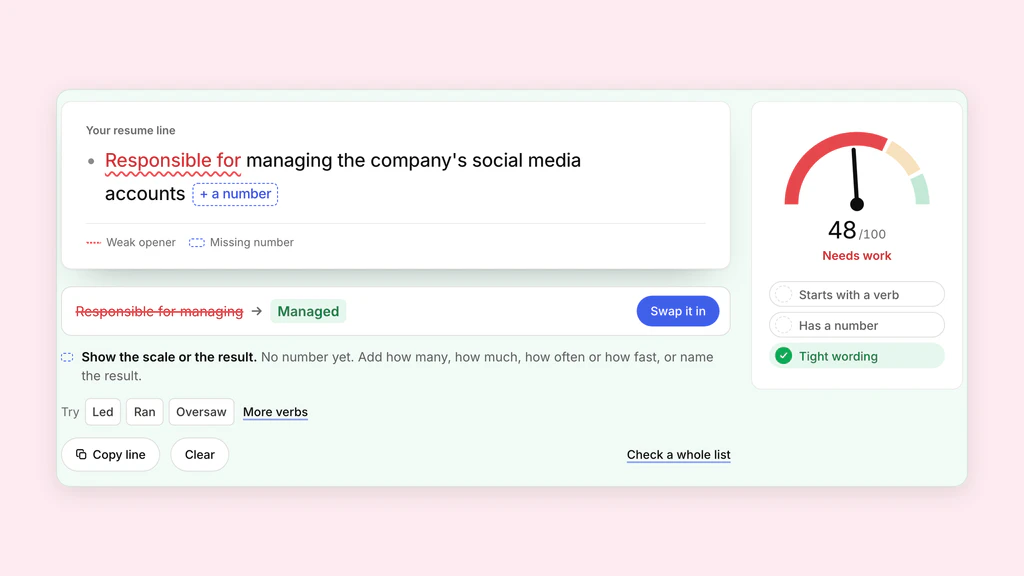
- Resume bullet checkerCheck the results you plan to quote. A vague bullet makes a vague letter.
Sources and further reading
- Cover letters: cover letter breakdown, Purdue University Center for Career Opportunities
- Job search letters, Purdue Online Writing Lab
- Create a resume, CV, or cover letter, Harvard FAS Mignone Center for Career Success
Put it into practice on a real resume.
Each example is a complete resume with role keywords and bullets that show proof. Open one in the Studio and make it yours, no account needed.